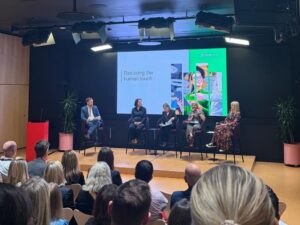
Redesigning work for the age of AI: insights from the Marsh Asia HR Conference
Key insights
- HR is entering a new value-creation era. Business, workforce and AI strategies must work together to redesign work for stronger productivity, agility and long-term growth.
- AI should enhance human capability, not replace it. The greatest opportunity lies in combining technology with skills, organisational design, trust and leadership judgement, rather than using AI purely to cut costs.
- Junior-role reductions pose a succession challenge. As more CEOs plan to reduce entry-level roles, employers need to protect talent pipelines and balance short-term efficiency with sustainable workforce planning.
- Asia-Pacific remains a major growth market. Employers are investing in internal skills and mobility while seeking leaders who can manage transformation, ambiguity and future-ready teams.
Frazer Jones once again had the privilege of participating in the Marsh Asia HR Conference 2026 in Singapore, bringing together more than 250 CEOs, CHROs, investors and business leaders from across the globe to discuss one of the defining leadership challenges of our time: how organisations can drive exponential performance and “work better”.
A particular thank you to Lewis Garrad, Asia Workforce & Rewards Region Leader, and the wider Marsh leadership team for delivering an exceptional event. The conference reflected Marsh’s distinctive position at the intersection of strategy, risk, talent and transformation, combining robust data with practical insight for business leaders navigating an increasingly complex world.
What became abundantly clear across the two days is that HR has entered a new era, at a pivotal moment of change.
The focus has shifted decisively towards value creation. Leadership teams are asking a more fundamental question:
How can organisations redesign work itself to unlock greater productivity, agility and growth?
Every PE-backed business has an agenda. It may be to accelerate growthDrawing on Marsh’s Global Talent Trends 2026 report research, four interconnected themes emerged:
- Reinvent for human advantage
- Leap forward with insight
- Recalibrate the value exchange
- Unleash a new era of HR
Together, they point towards a future where business strategy, workforce strategy and AI strategy become inseparable. HR leaders should leverage intelligence to drive strategic foresight with a focus on the employer-employee relationship, continuing to look forward and design outwards to building resilient and high performing workforces over the years ahead.
Despite rapid advancements in AI, the true differentiator and north star remains human capability
Trust, employee listening, judgement, contextual decision-making and leadership accountability continue to sit firmly at the centre of organisational performance.
While AI is transforming how work gets done, leaders must resist the temptation to view technology as simply a cost-reduction tool. Instead, the most forward-thinking organisations are already redesigning work end-to-end, combining technology, skills, which are the golden thread, and organisational structure to create entirely new operating models far beyond just optimizing, automating and leveraging AI agents.
Several leading organisations shared compelling examples of this transformation in practice, demonstrating how closer collaboration between HR, business leaders, technology & AI teams will drive measurable outcomes. Jepson Taylor (Chief AI Strategist and SME) asked the probing question, “what if AI outplayed humans and/or HR”.
One statistic resonated strongly: 43% of CEOs are planning to reduce junior roles, more than doubling from 17% a year ago. This presents both opportunity and risk. While productivity may increase leadership and long-term succession plans will be impacted.
The organisations that successfully balance AI adoption with talent sustainability, workforce planning and succession management are likely to create a significant long-term competitive advantage.
Growth remains resilient across Asia-Pacific
Despite ongoing geopolitical uncertainty and economic headwinds, the outlook across Asia remains remarkably positive.
Markets including Singapore, India and Vietnam continue to attract significant investment, while technology and AI-related sectors remain powerful drivers of regional growth.
Against this backdrop, organisations are becoming increasingly selective in how they deploy capital and talent. The emphasis is shifting towards building critical capabilities internally, investing in skills development and encouraging greater workforce mobility, while reserving external hiring for strategically important “must have” hires.
From a search and talent advisory perspective, we continue to see employers placing a premium on leaders who can navigate transformation, manage ambiguity, and build future-ready teams.
The challenge is no longer simply attracting talent. It is identifying the capabilities that will matter most five or ten years from now and building them before competitors do.
The CEOs and CHROs who win will move first
If there was one overarching message from the conference, it was this:
The organisations that outperform over the next decade will be those that move decisively today, optimising costs, redesigning work, investing in skills, and creating operating models fit for an AI-enabled future, creating value.
For CEOs and CHROs alike, the question is no longer whether change is coming. It is whether your workforce will be ready when it arrives. The time to act is now. Lead with the desired outcomes upfront: what problem are you trying to solve, what does success look like and work backwards!
Importantly, employee thriving has dropped from 66% to 44% in the last year globally. Employers should ask themselves one simple question at all levels of the organisation: if your best people were approached tomorrow, would they stay?
At Frazer Jones, we are privileged to partner with leading organisations around the world as they navigate these challenges. Alongside leading advisers such as Marsh, our shared mission remains clear: helping leaders build the HR talent, capability and organisational resilience required for the future.
Because in a world increasingly enabled by AI, competitive advantage will still come down to one thing: people.
If any of the themes discussed pique your interest and you would like to explore them further, I highly recommend reaching out to Lewis and his team.
Note: The data presented is sourced from the Marsh Global 2026 Human Capital trends report.