Keeping hiring human in the age of AI
Key insights
- AI should be viewed as a business transformation tool, not simply a productivity tool.
- Organisations creating the most value from AI are focusing on strategy, people and outcomes rather than technology alone.
- Candidate experience improves when AI creates more time for meaningful human interaction, not less.
- Human judgement remains critical for hiring decisions, particularly when assessing potential, cultural fit and leadership capability.
- The most successful organisations will use AI to enhance the human touch rather than replace it.
Artificial intelligence is rapidly changing the way organisations attract, hire and develop talent. From generative AI and AI agents to sophisticated AI tools that support everything from resume screening to onboarding, the pace of change continues to accelerate. Yet as technology becomes more embedded in everyday working life, a critical question remains: how can businesses embrace the benefits of AI without losing the human connections that underpin great hiring and employee experiences?
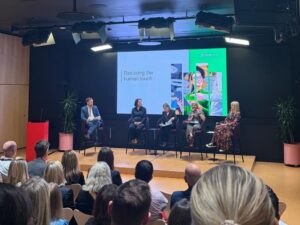
At a recent Frazer Jones panel event, Keeping hiring human in the age of AI, Global Managing Director Nick Croucher was joined by AI and business transformation experts Josie West, Shefaly Yogendra Ph.D., Rachael Woodman and Vicky Quinn. Together they explored where artificial intelligence is delivering real value, the risks organisations need to consider, and why empathy, emotional intelligence, critical thinking and other human skills will become even more important in an AI-enabled future.
Looking beyond AI hype and focusing on business value
“The winners are going to win when they’ve got the ambition and the appetite to actually move forward.”
Josie West
Much of the discussion centred on the gap between organisations’ enthusiasm for AI and their ability to use it strategically.
While many businesses have embraced AI tools to increase personal productivity gains, the panel questioned whether organisations are spending enough time considering how artificial intelligence can transform business models, customer experiences and workforce strategies.
Josie West argued that productivity alone is often an incomplete measure of success. While AI can help individuals complete tasks more quickly, organisations should be asking how that time is being reinvested and whether it is creating greater value for customers, employees and stakeholders.
The panel agreed that many organisations remain focused on tactical AI adoption rather than broader transformation. The challenge is not simply deploying AI tools, ChatGPT or other GenAI platforms, but creating a clear vision for how technology can support long-term business objectives.
For HR leaders, this means looking beyond efficiency gains and considering how AI can support workforce planning, organisational design, upskilling programmes and capability building at scale. As the future of work continues to evolve, organisations that combine technology with adaptability will be best positioned to succeed.
Candidate experience needs more than automation
“Once you start using AI, it’s pretty straightforward. It’s not how you’re using the AI, it’s how you’re then going to make the most of that.”
Vicky Quinn
One of the most striking discussion points came from audience polling, which found that many respondents felt AI had damaged the candidate experience rather than improved it.
The panel suggested this perception may be less about AI itself and more about how organisations are choosing to use it.
Vicky Quinn highlighted the significant time savings AI can create for recruiters, with many professionals now able to automate administrative tasks, data entry and repetitive processes that once consumed a large portion of their week. However, she challenged organisations to think carefully about how that time is reinvested.
Rather than simply processing more applications or increasing workload, AI should create space for higher quality conversations with hiring managers and candidates. Better understanding role requirements, refining job descriptions, providing clearer communication and delivering more meaningful feedback are all areas where the human touch continues to matter.
The discussion also touched on the growing complexity of the hiring process. As candidates increasingly use generative AI and tools such as ChatGPT to tailor CVs and applications, recruitment processes must continue evolving to identify genuine skills, potential and suitability.
For organisations investing in AI recruitment technology, the challenge is ensuring that algorithms support decision-making rather than replacing it entirely. The consensus from the panel was clear: candidate experience is unlikely to improve through automation alone. Human judgment remains essential.
Human judgement still matters in hiring decisions
“The last question I ask is: why shouldn’t we hire you?”
Shefaly Yogendra Ph.D.
While AI can support sourcing, screening and administration, the panel repeatedly returned to the importance of human judgment throughout the recruitment process.
Drawing on her experience advising boards and senior leaders, Shefaly Yogendra explained that some of the most valuable insights emerge when candidates are challenged, asked unexpected questions and given the opportunity to demonstrate how they think under pressure.
These moments often reveal critical thinking, self-awareness and emotional intelligence that cannot easily be identified through structured assessments or automated screening processes.
The conversation also explored the importance of fairness, governance and accountability. As organisations use increasing amounts of technology throughout the hiring process, leaders need to understand how decisions are made, how candidate data is managed and who remains accountable for outcomes.
The panel stressed that organisations committed to building inclusive cultures must ensure that the technology supporting recruitment reflects those same principles. Maintaining humans in the loop becomes particularly important when AI systems are being used to inform decisions that can significantly impact careers and opportunities.
Ultimately, AI can support better decisions, but it should not replace the human responsibility for making them.
Creating an employee experience that feels more human
“Great employee experience is going to feel the same whether it’s an AI-enabled organisation or not an AI-enabled organisation.”
Rachael Woodman
When discussing employee experience, the panel argued that AI should enhance human connection rather than replace it.
Rachael Woodman shared examples from organisations using technology to remove administrative burdens and create more meaningful experiences throughout the employee lifecycle. By automating routine tasks, organisations can free up time for managers and human resources teams to focus on recognition, engagement, culture and development.
The panel agreed that great employee experiences are still built on the same fundamentals they always have been: feeling valued, feeling connected and understanding how your contributions matter. Psychological safety, empathy and a strong sense of belonging remain vital regardless of how advanced workplace technology becomes.
AI can help facilitate those experiences, but it cannot create them on its own.
The discussion highlighted examples such as interview note-taking technology, which allows hiring managers to be more present in conversations, and onboarding programmes that combine digital efficiency with purposeful human interaction.
As organisations continue adopting AI at work, the most successful employers will be those that use technology to strengthen relationships rather than reduce them. The human element remains the differentiator.
AI strategy should be a business strategy
“There is no such thing as an AI strategy.”
Shefaly Yogendra Ph.D.
Another recurring theme throughout the event was the misconception that AI should be treated as a standalone initiative.
Both Shefaly Yogendra and Josie West emphasised that organisations should start by identifying their most important business challenges. The real question is not whether AI should be adopted, but whether it can help solve specific strategic problems more effectively.
This shift in thinking has important implications for HR leaders. Instead of viewing AI as a technology project owned by one function, organisations should consider how it influences operating models, organisational structures, capability requirements and workforce planning.
The panel also discussed growing investor interest in AI maturity, particularly among organisations preparing for investment or navigating growth and transformation. However, a compelling AI story is ultimately about value creation, not technology deployment.
The organisations seeing the greatest benefits are typically those that focus on people, behaviour change, reskilling, upskilling and strategic outcomes alongside the tools themselves. Successful AI adoption is rarely about technology in isolation. It is about aligning technology with business goals and human values.
Preparing for the future of work
“I would say I think we need to leverage AI. Not so much to audit our workforce and our head count, but instead to audit the skills.”
Vicky Quinn
As organisations look ahead, the discussion increasingly focused on skills rather than roles.
The panel highlighted how rapidly the job market is changing and the need for organisations to better understand their existing capabilities, future talent requirements and leadership gaps. This is particularly important as AI agents and automation take on more routine responsibilities.
Rather than concentrating solely on headcount reduction, HR leaders should be thinking about how AI can strengthen the talent pipeline, identify emerging capability needs and support more effective workforce planning.
The conversation also touched on early careers and the importance of ensuring future leaders continue to develop commercial awareness, business judgement and interpersonal skills. As routine work becomes more automated, organisations will need to think differently about how they develop talent and create opportunities for learning.
The future of work will demand greater adaptability from organisations and individuals alike. The businesses that thrive are likely to be those that invest in both technological capability and human potential.
The future of work will demand greater adaptability from organisations and individuals alike. The businesses that thrive are likely to be those that invest in both technological capability and human potential.
The future belongs to organisations that protect the human element
“The organisations who keep the human touch, whether it’s in recruitment or other areas, will win.”
Josie West
As the discussion drew to a close, panellists reflected on what HR leaders should prioritise over the next 12 months.
Suggestions ranged from auditing workforce skills and preparing for AI-enabled operating models to rethinking organisational design and identifying the moments in the employee journey that should always remain human-led.
While views differed on how rapidly AI will reshape the workplace, there was broad agreement on one point: technology will continue advancing, but human skills will become more valuable, not less.
Empathy, critical thinking, emotional intelligence, relationship building, human judgment, adaptability and leadership remain qualities that organisations cannot afford to lose. These capabilities will become increasingly important as AI tools, algorithms and generative AI become standard parts of everyday work.
The challenge for HR leaders is therefore not choosing between AI and people. It is finding the right balance between the two.
As organisations continue navigating this transformation, those that use artificial intelligence to create more meaningful human experiences, rather than fewer, are likely to be the ones that stand out to both candidates and employees. The future will not belong to organisations that simply automate faster. It will belong to those that successfully combine technology with the human touch.
How Frazer Jones can help
As organisations continue to invest in AI, transformation and future workforce capabilities, the demand for skilled HR professionals is only increasing.
Whether you’re looking to hire a Chief People Officer, HR transformation specialist, organisational development leader, talent acquisition expert or HR technology professional, Frazer Jones can help you identify the talent needed to navigate change successfully.
Our specialist consultants work with organisations across industries to hire HR professionals with expertise in transformation, workforce planning, employee relations, learning and development, HRIS and organisational design.
Explore our latest jobs, learn more about our executive search or browse our resources for further guidance on AI, people strategy and the future of work.
As the relationship between people and technology continues to evolve, having the right HR capability in place will be one of the most important competitive advantages any organisation can build.
Author