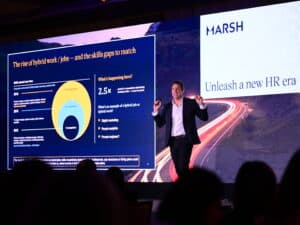
View from the top – Global HR leadership series. Interview with Steve Scott (MD, Global People Insights and Analytics, FS).

In the latest installment of Frazer Jones’ global HR Executive leadership series, View From The Top, Charlotte Matthew, Managing Director of the Global Financial Services Practice and Head of Southeast Asia, engages in a compelling conversation with Steve Scott, MD, Global People Insights and Analytics, Financial Services, widely regarded as one of the most influential thought leaders in the financial services sector.
With deep expertise in people insights, workforce analytics, and strategic workforce management, Steve shares his perspectives on the evolving role of data in shaping HR strategy and driving business performance across the industry.
Steve has had a distinguished career spanning senior leadership roles at Lloyds Banking Group and Barclays. His experience uniquely positioned him to lead and evolve the group-wide people analytics function, as MD at Standard Chartered Bank (SCB) based in Singapore.
In this compelling conversation, Steve shares his transformative journey in shaping SCB’s global people analytics strategy. He offers actionable insights into how data-driven workforce decisions can unlock enterprise value and elevate human capital. His perspective is especially relevant for CHROs, Global Heads of Reward, and senior HR leaders seeking to harness people intelligence as a strategic lever for business performance.
Your remit at SCB spanned People Insights, Analytics, and Workforce Management on a global scale. What were the defining moments or influences that led you to this intersection of data and people strategy, and how has your perspective evolved?
When I reflect on my time at Standard Chartered, two defining moments stand out, each shaping my belief in the power of people analytics to drive business value.
The first was during and immediately after COVID-19, when the organisation turned to HR to help navigate an unprecedented period of disruption. Our People Analytics team delivered insights that directly informed strategic decisions at the highest level. These included identifying roles best suited to hybrid work, assessing the impact of flexible working on productivity and engagement, and understanding how different work patterns correlated with business outcomes. We also analysed shifting attrition patterns, from the near-standstill during lockdowns to the surge of the ‘Great Resignation’, enabling the bank to make proactive decisions on retention and flexible working models.
The second pivotal moment came through our work in strategic workforce planning. By quantifying, in US dollars, the tangible value of reskilling and redeploying colleagues rather than releasing and rehiring, we were able to demonstrate the commercial, cultural, and human benefits of taking a long-term view of skills development. Through skills adjacency analysis, we highlighted where “sunset” roles could evolve into “sunrise” opportunities, ensuring the organisation could retain critical skills and capability while optimising costs.
These experiences reinforced my conviction that people analytics must always serve the business, connecting data and insights to decisions that drive measurable value for clients, shareholders, and colleagues. Over time, my perspective evolved further: to unlock value at scale, you must embed data competence across the entire HR function. A single analytics team cannot achieve this alone. True transformation comes when every HR professional is both data-confident and data-curious, using insights to inform daily decisions.
Under your leadership, how did Standard Chartered transform its approach to people analytics? Could you highlight the most impactful initiatives or innovations that have reshaped the function and delivered measurable value?
When I joined SCB, the People Analytics team was largely focused on manually producing thousands of operational reports. My goal was to transform this reporting function into a strategic analytics capability that informed business decisions and created value.
We began by automating, consolidating, and rationalising our reporting landscape, freeing capacity to focus on higher-value insights. I restructured the team, introduced new specialist roles, and aligned our priorities with business opportunities and risks. This shift from hindsight to a balance of hindsight, insight, and foresight unlocked significant business impact at both enterprise and market levels.
We also invested heavily in building data literacy across the HR function. Our aim was to enable every HR professional to use data confidently, not just the analytics team. Alongside this, we modernised our approach to strategic workforce planning, working closely with Finance to make the ‘position’, not just the headcount, the currency of planning. This allowed us to directly connect workforce plans to cost, and to design the future workforce in terms of size, shape, spend, and skills.
Ultimately, I believe there is no greater value than ensuring an organisation has the right people, in the right roles, at the right time, cost, and with the right skills to deliver its strategic and financial ambitions.
In a data-intensive industry like financial services, how do you ensure that people analytics translates into actionable insights that drive business value?
That’s a question I’ve challenged myself with throughout my career in HR. It’s easy for analytics teams to produce interesting insights, but “interesting” doesn’t always mean “valuable.”
To ensure our work created a genuine impact, I introduced a value-based prioritisation framework. Every analytics request had to clearly articulate the business problem we were solving, the decisions it would inform, and the potential value that insight could unlock. We then tracked outcomes, following up to understand what decisions were taken, what value was realised, and whether additional insight was needed.
We also made it standard practice to have both an HR and business sponsor for every major use case, ensuring accountability and alignment from the start. In my view, the journey from insight to action begins long before the data analysis, it starts by defining the business need with precision and purpose.
What have been the most significant challenges in embedding a data-driven mindset across HR and senior leadership? How did you navigate resistance or inertia to foster a culture of evidence-based decision-making?
Building a data-driven HR function rests on four pillars: skills, mindset, data quality, and accessible technology. Of these, mindset is often the most underestimated. You can invest in platforms and training, but unless HR professionals genuinely believe that using data and evidence is core to their role, behaviour won’t change.
At SCB, I was fortunate to have a highly data-driven CHRO and HR leadership team who visibly role-modelled evidence-based decision-making. With their sponsorship, we introduced an HR-wide objective focused on data learning and capability building, reinforcing that this was not optional, it was foundational. We updated job descriptions and interview criteria to embed data fluency as a core competency.
Changing mindsets takes time, consistency, and multiple interventions. There’s no single silver bullet, but with leadership sponsorship and structural reinforcement, you can shift the culture from intuition-led to insight-led decision-making.
Looking ahead, how do you envision the future of people analytics, particularly in the context of emerging technologies, evolving workforce expectations, and strategic business imperatives?
The future of people analytics lies in democratisation. Technology and AI are redefining how value is created, not by expanding central analytics teams, but by empowering business and HR leaders with real-time access to insights.
AI-driven tools can surface insights proactively, enable even non-technical users to interrogate data, and connect people metrics with financial and customer data to reveal new commercial correlations. This creates an extraordinary opportunity to democratise analytics, embedding evidence-based decision-making throughout the organisation.
As this evolution continues, the role of the People Analytics team must also shift, from producing reports and dashboards to focusing on advanced use cases, predictive modelling, and strategic enterprise collaboration. Far from being a threat, this is an exciting inflection point for the discipline, an opportunity to create deeper impact, elevate the function’s strategic relevance, and contribute meaningfully to business success.
For CHROs seeking to elevate their analytics capabilities, what strategic advice would you offer to help them unlock enterprise-wide impact and position people intelligence as a core driver of business success?
For CHROs seeking to elevate their analytics capabilities, my advice is twofold.
First, invest in technology and AI that democratise people insights across the organisation, enabling leaders at all levels to access, interpret, and act on data. But don’t allow the technology to become the goal in itself; the real success lies in the outcomes and value it enables.
Second, develop the mindsets and skill sets needed to make this possible. This includes building confidence in data usage, AI, connecting people data with financial and operational datasets, and fostering a culture where data is integral to decision-making.
Ultimately, CHROs who deeply link people analytics to business performance can position HR as a true strategic driver of enterprise value. The opportunity has never been greater, and I’m always happy to connect with peers who want to explore how to make that a reality.
Author

Executive Jobs in Financial Services
Whether you are looking to appoint a Group Head of People Analytics, a CHRO, or build out our global or regional HR Leadership Team, now is the time to act.
If you need expert assistance with executive recruitment or would like to discuss the current HR market, please reach out to Charlotte Matthew or one of our specialist consultants at Frazer Jones. We are here to help you navigate these challenges and find the right leadership talent for your organisation.
Similarly, if you are interested in joining our Frazer Jones CHRO “View from the top” programme, participating in upcoming HR Executive events in 2026 and beyond, do get in touch to register your interest!